A Map of Every Julia Set
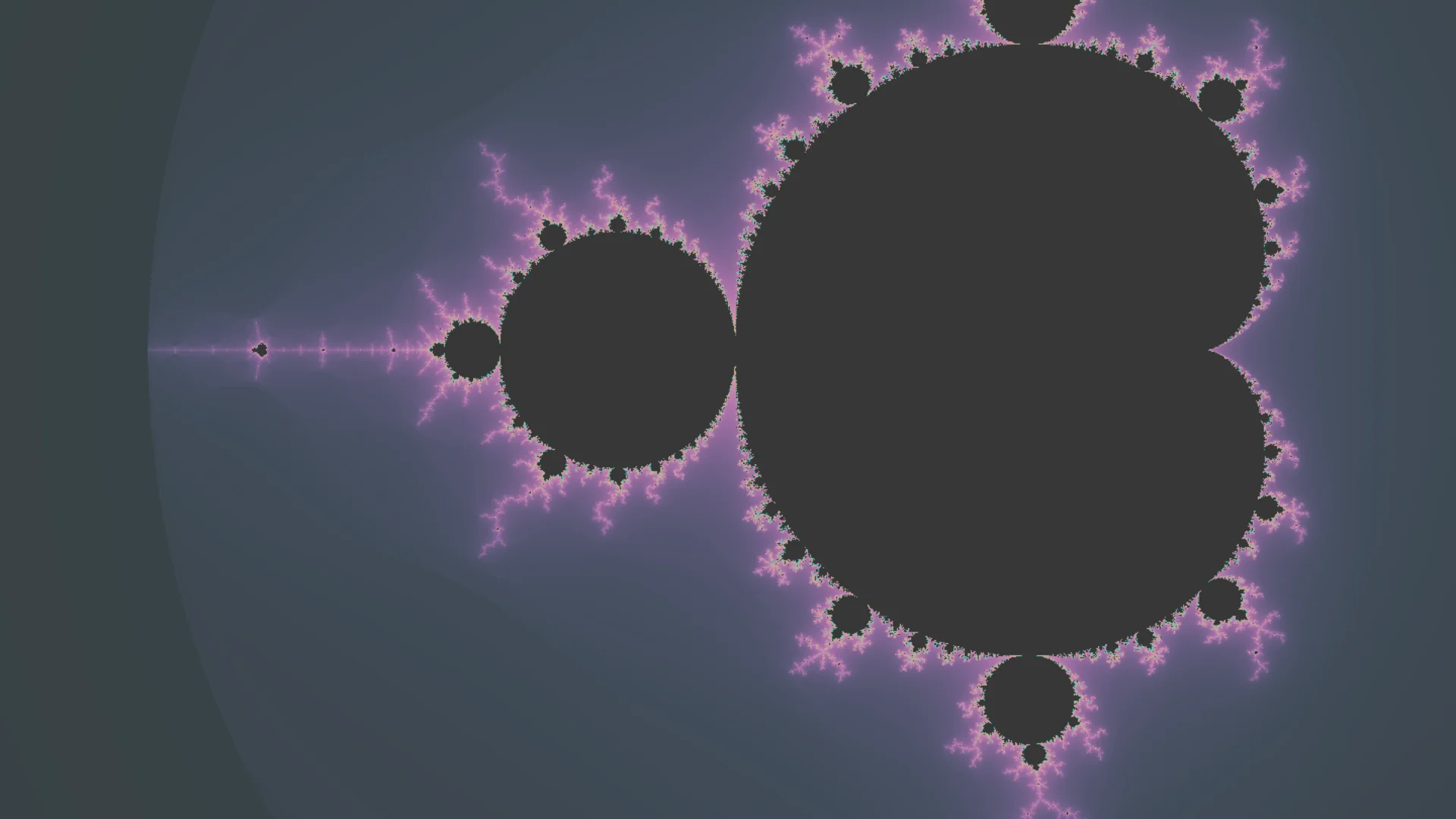
Here's the thing about the Mandelbrot set that takes a while to sink in: it's not just a fractal. It's an index of fractals. Every single point in the complex plane corresponds to a Julia set, and the Mandelbrot set tells you which of those Julia sets are connected (one piece) and which shatter into disconnected dust. Pick a point inside the Mandelbrot set, use it as c in the Julia iteration, and you get a connected shape. Pick a point outside, and the Julia set falls apart.
This means the Mandelbrot set is a map of all possible Julia set behaviors, organized by the parameter c. The boundary is where the action is. Points near the boundary produce Julia sets that are connected but barely holding together, with long tendrils and wild spirals. That's why the boundary itself is so complex.
The Formula
Take a complex number c. Start with z = 0. Repeatedly compute z → z² + c. If the result stays bounded (doesn't fly off to infinity), then c is in the Mandelbrot set. That's the whole definition.
In practice, if |z| ever exceeds 2, it will diverge, so that's the escape test. The number of iterations before escape determines the coloring of points outside the set. Points that never escape are colored black (or whatever you choose for the interior). The boundary between escaping and non-escaping points is where the fractal structure lives.
What Happens at Deep Zoom
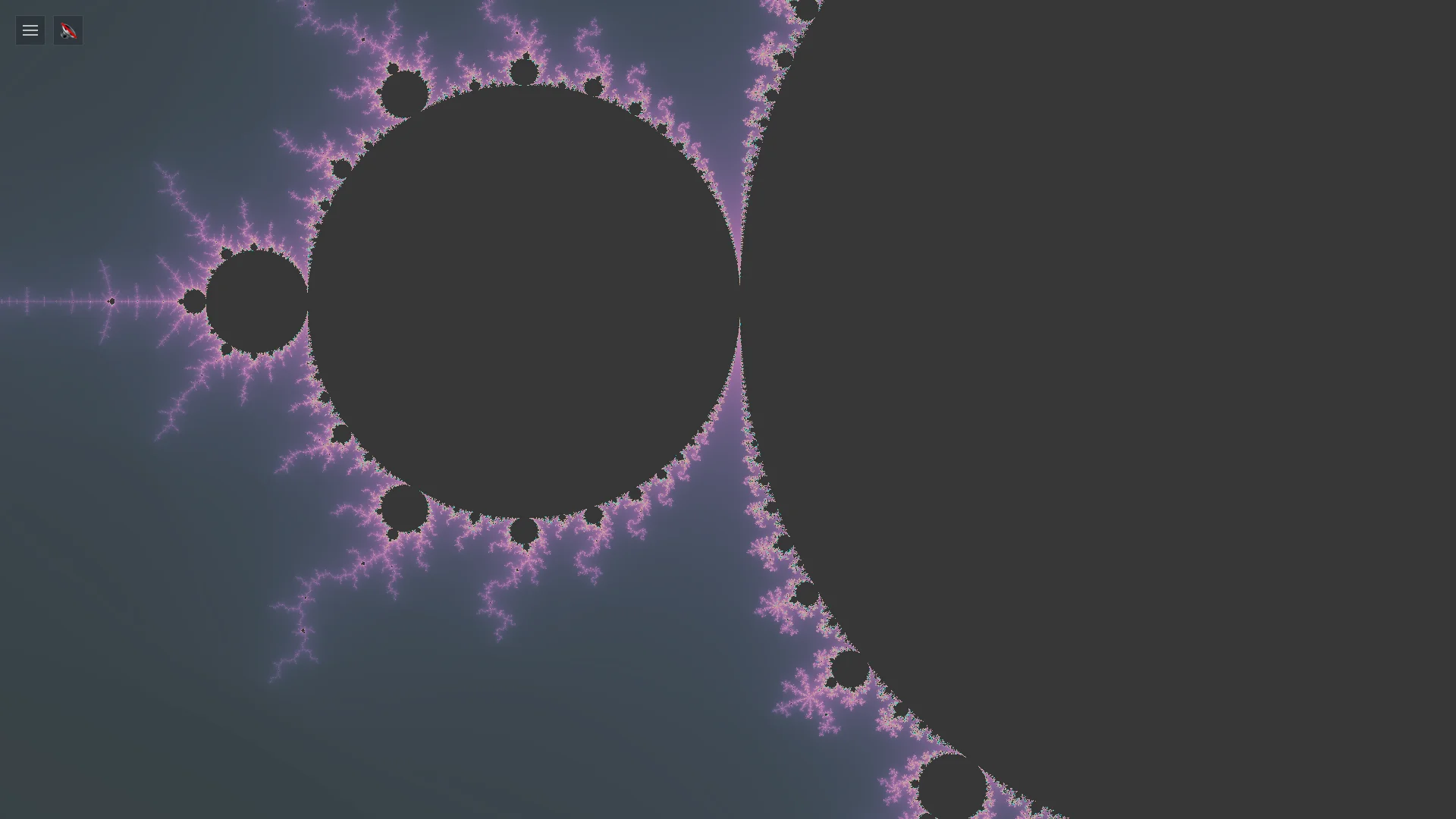
The boundary of the Mandelbrot set has Hausdorff dimension 2, which means it's so convoluted it effectively fills area at every scale. Zoom in on any boundary region and you'll find smaller copies of the full set, connected to each other by thin filaments. These mini-Mandelbrots appear everywhere, rotated, distorted, surrounded by their own spiral structures.
But there's a catch. Standard 64-bit floating point gives you about 15 significant digits, which means you can zoom in roughly 10^13 times before the image turns to mush. To go deeper, you need arbitrary precision math or perturbation theory (computing one reference orbit at full precision and deriving nearby pixels as offsets from it). Our visualizer does both, switching automatically when standard precision runs out. That's how you get to magnifications past 10^15 and beyond.
History
Benoit Mandelbrot first visualized it in 1980 at IBM, using mainframe computers. The iteration itself was studied earlier by Pierre Fatou and Gaston Julia in the 1910s and 1920s. But without computers, nobody could see the full picture. Mandelbrot could, and the images were so unexpected that they kicked off the popular fractal craze of the 1980s.
Adrien Douady and John Hubbard proved the set is connected in 1982. This was not obvious. The thin filaments connecting mini-Mandelbrots are so narrow they're invisible at most zoom levels, and early researchers suspected the set might actually be a collection of disconnected pieces. It isn't. Every part is connected to every other part, though the connections can be vanishingly thin.
Exploring It
Guided tour through several locations: Seahorse Valley, Elephant Valley, the antenna region, and various mini-Mandelbrot satellites.
Pans across the full set, moving between the main cardioid, the period-2 bulb, and the smaller bulbs along the boundary.
Uses perturbation theory to zoom past 10^15 magnification. Watch standard precision give way to arbitrary precision in real time.
Full manual control. Click to zoom, drag to pan, scroll to adjust magnification. Find your own mini-Mandelbrots.
Under the Hood
The visualizer runs on WebGL shaders, so the GPU handles the per-pixel iteration in parallel. At moderate zoom, standard double-precision floats are fast and accurate. Once you push past about 10^13 magnification, the renderer switches to perturbation theory: it computes a single reference orbit at arbitrary precision (using GMP-WASM), then calculates each pixel as a small offset from that reference. This is orders of magnitude faster than computing every pixel at full precision, and it's the same technique used by dedicated Mandelbrot zoom software like Kalles Fraktaler.
Further Reading
- Wikipedia - Mandelbrot set - solid overview of the math, history, and properties
- MathWorld - Mandelbrot Set - more formal treatment with proofs and references
- Julia-Mandelbrot Relationship - our page on how these two fractals connect