Mathematical Foundation
Newton fractals visualize the convergence behavior of Newton's method for finding roots of equations in the complex plane. Newton's method is a centuries-old algorithm that iteratively approximates the roots of a function using the formula: z_{n+1} = z_n - f(z_n)/f'(z_n).
When applied to complex functions, this seemingly straightforward numerical method reveals stunning fractal patterns at the boundaries between different basins of attraction.
The Emergence of Chaos
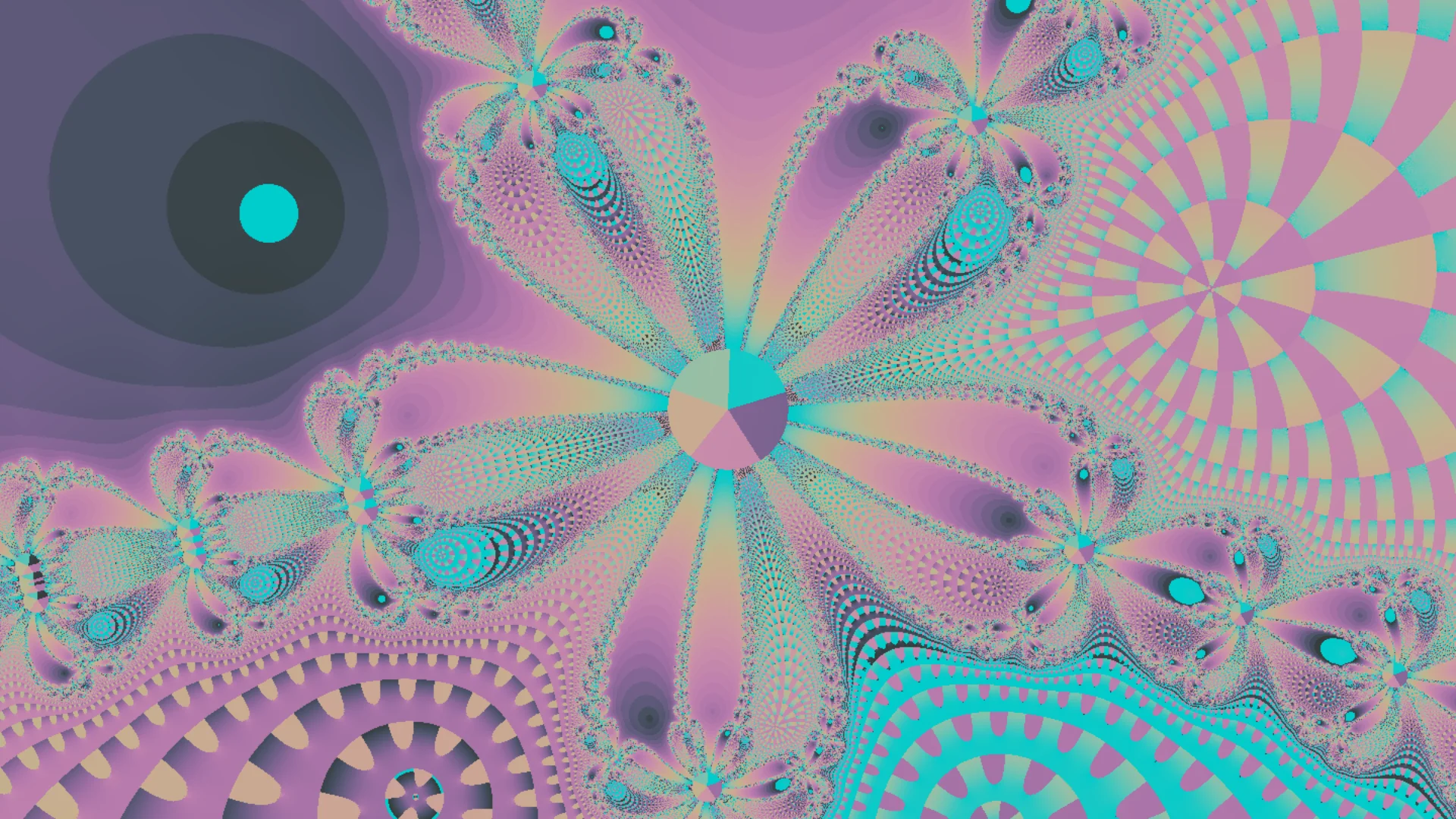
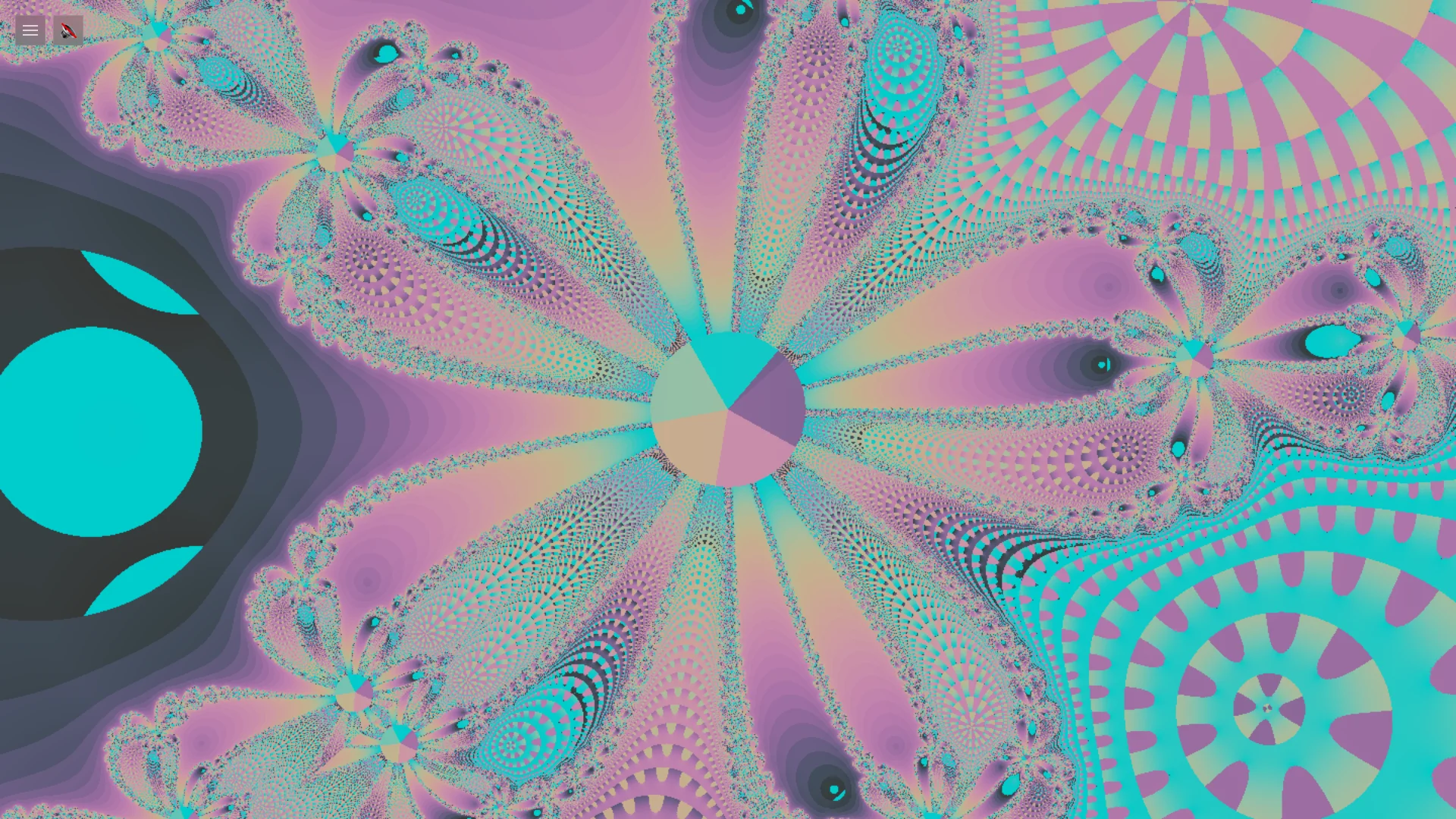
The Newton fractal comes from applying Newton's method to complex functions. Instead of smoothly converging to a root, the method produces a patchwork of "basins of attraction," where each points colour shows which root the iteration will settle on. The boundaries between these regions are infinitely intricate, and no matter how much you zoom in, they remain tangled and unpredictable.
A particularly fascinating fact is that this chaos emerges from a process that's normally taught in first-year calculus as a neat, deterministic root-finding trick - it's a reminder that even simple, practical algorithms can hide fractal beauty when you step into the complex plane.
Historically, Newton never saw these patterns; they only became known with computer visualization in the 20th century. Our implementation adds mathematical complexity beyond the pure Newton method to create more visually interesting effects.
Animation Methods
Our Newton fractal visualizer offers multiple animation techniques to explore this mathematical landscape:
Creates a chaotic mathematical storm effect, emphasizing the turbulent nature of the fractal boundaries and the unpredictable convergence patterns.
Rotates the view continuously, revealing how the fractal structure maintains its complexity from every angle while creating mesmerizing spiral patterns.
Smooth rhythmic movements through parameter space, creating flowing transitions that highlight the fractal's organic, dance-like transformations.
Give this one some time - it gets more interesting :-)
Dynamic flame-like visual effects that emphasize the fractal's fiery, energetic appearance with flowing, organic movements.
Manual control with keyboard or touch, allowing detailed exploration of the fractal's structure and convergence patterns.
Technical Implementation
GPU-Accelerated Computation
Our Newton fractal renderer uses WebGL shaders to perform the iterative calculations on the GPU, enabling real-time exploration of complex mathematical structures with high iteration counts.
Basins of Attraction
Each colour in the fractal represents a different root that Newton's method converges to. The fractal boundary shows the chaotic regions where small changes in starting position lead to convergence to completely different roots.
Enhanced Visualization
Beyond standard Newton fractals, our implementation includes additional mathematical complexity to create more visually striking patterns while maintaining the core mathematical principles.
Mathematical Significance
Newton fractals demonstrate fundamental concepts in complex dynamics, chaos theory, and numerical analysis. They show how:
- Deterministic systems can exhibit chaotic behavior at boundaries
- Simple algorithms can produce infinite complexity when extended to complex numbers
- Numerical methods have fractal sensitivity to initial conditions
- Mathematical beauty emerges from practical computational tools
Further Reading
Explore these canonical resources to deepen your understanding of Newton fractals:
- Wikipedia - Newton's Method - Comprehensive mathematical reference on the foundational algorithm
- Isaac Newton Biography - Learn about the mathematician and physicist who developed the method
- Wikipedia - Newton Fractal - Mathematical details on Newton fractals and basins of attraction