How It Works
The Mandelbox doesn't use complex number iteration like the Mandelbrot set. Instead, it folds space. Each iteration applies two geometric operations - a box fold and a sphere fold - then scales the result and adds an offset. That's it. Three steps, repeated.
The box fold reflects any component that exceeds a limit back toward the origin. Think of it as folding a sheet of paper at defined creases. The sphere fold does something different: points inside a minimum radius get pushed outward, while points between the minimum and fixed radius get inverted through the sphere. Points beyond the fixed radius are left alone.
These two operations fight each other. The box fold wants flat planes and sharp angles. The sphere fold wants curves. The result looks like neither and both at once.
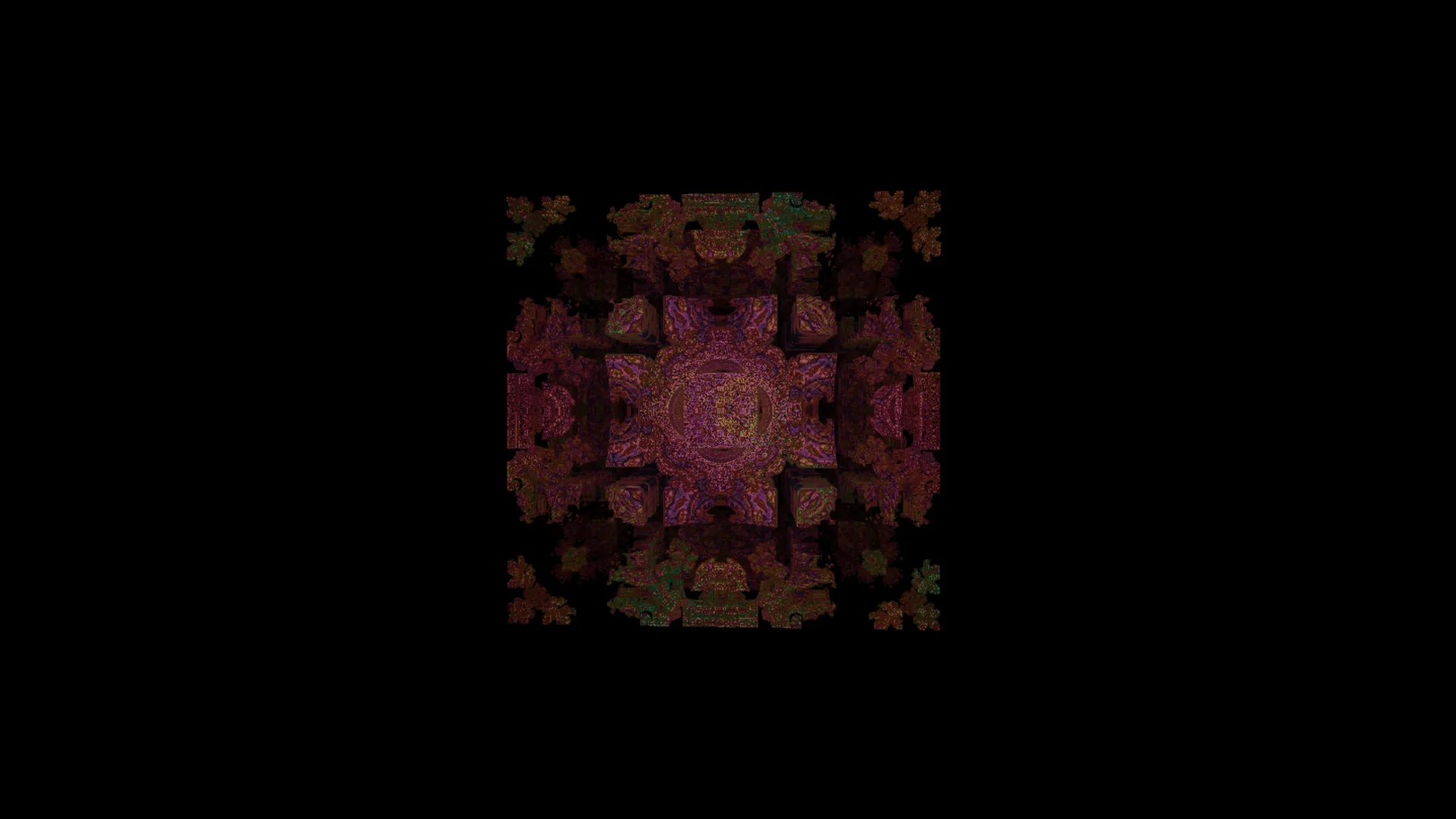
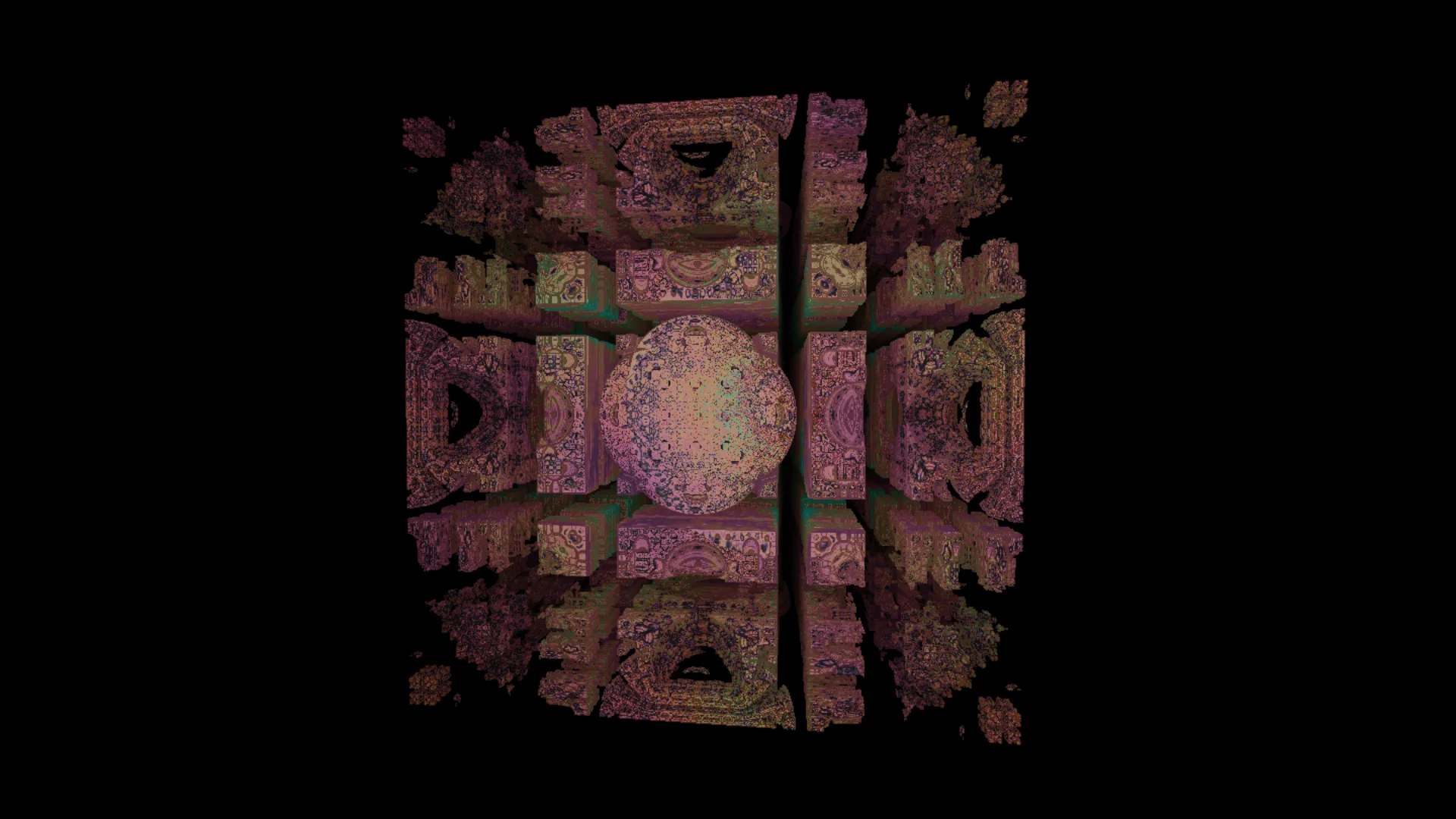
What It Looks Like
The Mandelbox is a strange object. Depending on the scale parameter, it can look like a ruined cathedral, a coral reef, an alien city, or a crumpled ball of foil. Sometimes all of those in the same render.
The Box Fold's Fingerprint
You can always tell the box fold is at work. Flat faces, right angles, geometric regularity - the kind of structure you'd expect from architecture, not nature. At certain scales, the fractal develops rows of identical pillars and corridors. Zoom in and you find smaller corridors inside those corridors.
The Sphere Fold's Contribution
The sphere fold rounds things off, inflates surfaces, and creates the bulging, almost biological shapes you see in between the flat panels. The ratio between the minimum and fixed radius controls how much inflation happens. Tight ratios give you something bony and structural. Wide ratios make it look like the geometry is melting.
The Scale Parameter
Scale changes everything. At -1.5, you get tight, spiky detail. At -2.0, the classic "boxed" look. Near -2.5, the structure opens up into something organic and porous. Positive scale values produce a completely different family of shapes. A change of 0.1 in scale can turn a solid block into lace.
Rendering
The Mandelbox is rendered with ray marching, not polygons. A distance estimator function tells the ray marcher how close each point is to the fractal surface. The DE function tracks how the folding operations stretch and compress space - it multiplies the derivative through each iteration to estimate a safe step size. This lets the renderer walk rays through the scene without missing thin features or punching through walls.
Exploring It
Circles the structure from the outside, showing how its silhouette changes from every angle.
Flies through corridors and chambers inside the fractal. This is where you see the self-similarity up close.
Smoothly shifts scale, radius, and fold limits so you can watch the structure reshape itself in real time.
Pushes into the surface to find smaller copies of the larger geometry nested inside.
Full manual control with WASD, QE, or touch. Go where you want.
Origin
Tom Lowe (known online as Tglad) introduced the Mandelbox in early 2010 on FractalForums.com. He was experimenting with folding operations in 3D - box folds and sphere folds applied iteratively - to see if they could produce bounded, self-similar structures the way the Mandelbrot iteration does in 2D. They could, and the results were immediately unlike any other 3D fractal.
What set the Mandelbox apart was its versatility. The Mandelbulb, discovered a few months earlier, has a fixed character - always bulbous, always rounded. The Mandelbox can look entirely different with a small parameter tweak. That range made it a favorite for fractal artists and for people trying to understand what "folding" operations actually do to space.